
If you use a coworking space three or more days a week, a dedicated desk almost always wins on value. If you show up once or twice a week (or just whenever the mood strikes), a hot desk is the smarter, cheaper call. That’s the short version. Here’s everything else you need to pick the right one.
Quick comparison at a glance:
- Cost: Hot desks are cheaper upfront; dedicated desks cost more but deliver better value for frequent users
- Flexibility: Hot desks offer maximum flexibility with no fixed commitment; dedicated desks lock you into one spot
- Personalization: Hot desks offer zero; dedicated desks let you set up monitors, accessories, and your beloved coffee mug
- Storage: Hot desks give you a locker; dedicated desks give you lockable drawers right at your seat
- Privacy: Both sit in shared spaces, but dedicated desks offer more consistency and predictability
- Networking: Hot desks rotate your neighbors daily (great for breadth); dedicated desks build deeper bonds with the same people
| Factor | Hot Desk | Dedicated Desk |
|---|---|---|
| Monthly cost | Lower | Higher |
| Desk assignment | First-come, first-served | Permanently yours |
| Personalization | None | Full |
| Storage | Shared lockers | Lockable desk storage |
| Setup time | Daily | Zero |
| Best for | Occasional users, freelancers, nomads | Regular users, focused roles, teams |
Table of Contents
- What is a dedicated desk?
- What is a hot desk?
- Dedicated desk vs hot desk: how do they really compare?
- How to choose the best workspace setup for you
- What the research and real-world experience tell us
- Centro fits wherever you land on this decision
- Key Takeaways
What is a dedicated desk?
A dedicated desk is a permanently assigned workstation inside a shared office environment. You get the same seat every single day, and nobody else touches it. Think of it as your own little corner of the world, minus the mortgage.

Unlike a private office, a dedicated desk sits in a communal area. The difference is ownership. Your monitors stay put. Your ergonomic setup stays put. That slightly embarrassing motivational sticky note stays put too. You can personalize the space to actually support how you work, rather than adapting to whatever the previous occupant left behind.
Features of a dedicated desk:
- Permanently assigned workstation in a shared space
- Lockable storage at the desk (not just a shared locker down the hall)
- Ability to leave monitors, docks, and equipment set up permanently
- Consistent ergonomic configuration every day
- Access to shared amenities like meeting rooms, Wi-Fi, and kitchens
- Personalization within the operator’s guidelines
Pros of a dedicated desk:
- No daily setup friction. Sit down, open your laptop, get to work.
- Consistent environment helps your brain shift into focus mode faster
- Secure physical storage for sensitive documents or specialist equipment
- Builds a genuine sense of belonging over time
- Better suited to deep, project-intensive work
Cons of a dedicated desk:
- Higher monthly cost than a hot desk
- Less flexibility if your schedule changes suddenly
- You’re paying for the space even on days you don’t show up
- Usually involves a monthly or longer commitment
Who should choose a dedicated desk?
Professionals in compliance-heavy fields like legal, finance, and healthcare often need dedicated desks for privacy and secure document storage. But it’s not just regulated industries. If you’re in the office four or more days a week, use multiple monitors, handle sensitive calls, or simply hate the daily ritual of hunting for a decent seat, a dedicated desk is your natural home.
Pro Tip: If you’re managing multiple ongoing projects with physical materials, a dedicated desk pays for itself in time saved alone. No more repacking your bag every evening like you’re checking out of a hotel.
What is a hot desk?
A hot desk is an unassigned workstation in a shared office or coworking space. You show up, find an open seat, plug in, and get to work. No permanent spot, no guarantees, no drama (usually). Each day might bring a different desk, a different view, and different neighbors.
Hot desking traditionally runs on a first-come, first-served basis. But the model has evolved. Desk hoteling, a reservation-based variant, lets you book a specific desk in advance through a booking system, similar to reserving a hotel room. It keeps the cost benefits of shared desks while removing the daily uncertainty of scrambling for a seat. By 2025, reservation-based hoteling had become the preferred modern approach as pure first-come setups declined.
Features of a hot desk:
- No permanent assignment; use any available desk on arrival or via booking
- Shared amenities including Wi-Fi, phone booths, and meeting rooms
- Clean-desk policy required at the end of each session
- Shared locker storage for personal items
- Flexible membership options: daily, weekly, or monthly
Pros of a hot desk:
- Lower cost, especially for part-time or occasional users
- Maximum flexibility with no long-term commitment
- Daily rotation of neighbors creates broad networking opportunities
- Great for testing a coworking space before committing to a dedicated plan
- Supports hybrid schedules where office attendance varies week to week
Cons of a hot desk:
- No personalization whatsoever; pack up everything at day’s end
- Daily setup takes time and mental energy
- No guaranteed seat during peak hours
- Less suitable for roles requiring heavy equipment or confidential calls
Who should choose a hot desk?
Hot desks work best for freelancers, consultants, digital nomads, and hybrid workers who visit the office once or twice a week. If your schedule shifts constantly, you travel frequently, or you’re still figuring out how often you actually want to be in a coworking space, a hot desk lets you pay only for what you use.

Pro Tip: Starting with a hot desk is a genuinely smart move. Use it for a month or two to track how often you actually show up. If you’re there more than three days a week, that’s your sign to upgrade.
Dedicated desk vs hot desk: how do they really compare?
The surface-level difference is obvious. One desk is yours; the other is everyone’s. But the real gap shows up in the details.
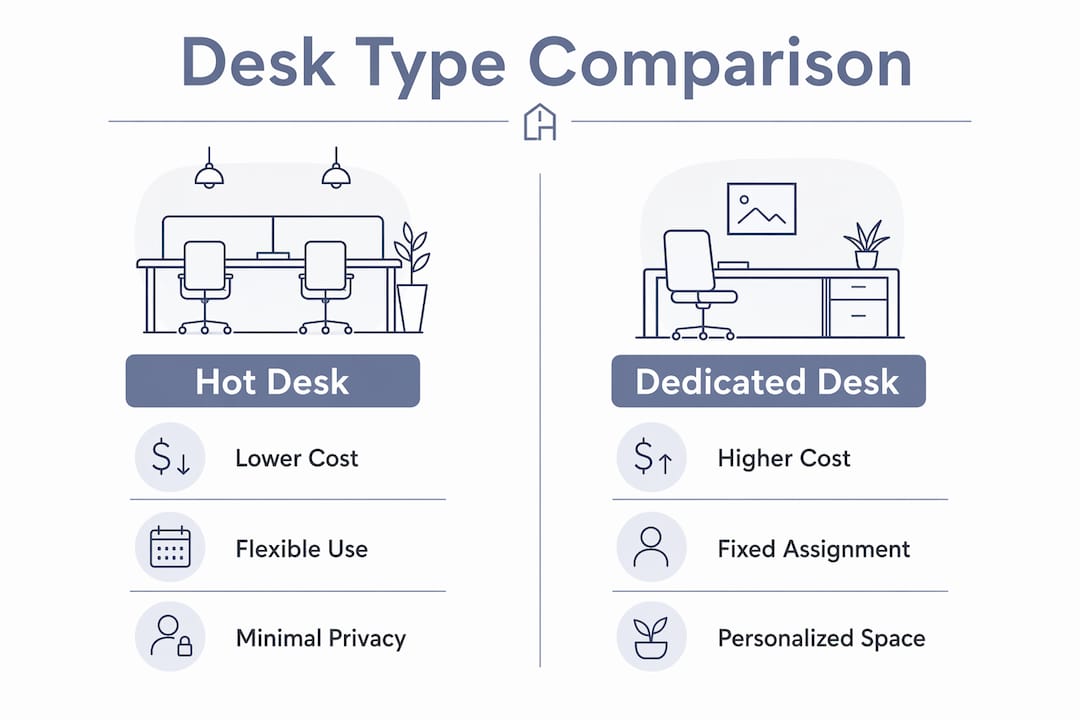
Cost
Hot desks are cheaper on paper. You pay per day or per month for access to a pool of shared desks, and you’re not reserving space that sits empty when you’re not there. Dedicated desks cost more because the space is reserved for you 24/7 regardless of use. But here’s where it gets interesting: hidden costs flip the equation for regular users. Daily setup and breakdown can consume 15–30 minutes per day. Over a full month, that’s real time lost.
Flexibility and commitment
Hot desks win on flexibility, full stop. No fixed desk, no long-term contract, scale up or down as projects demand. Dedicated desks trade that freedom for consistency. You commit to a specific spot, which limits rapid changes but creates a stable, predictable workday.
Privacy and personalization
Hot desks offer minimal personal space. You can’t leave confidential materials behind, and conversations happen in open areas with rotating strangers. Dedicated desks provide a semi-private experience: same neighbors, lockable storage, and a consistent setup that improves both security and comfort.
Productivity
The daily setup friction of hot desking, finding a seat, adjusting equipment, connecting devices, can add five to ten minutes of lost productivity per session. That’s before accounting for the cognitive load of adapting to a new environment every morning. Dedicated desks remove this entirely. A consistent workspace supports routine, reduces decision fatigue, and helps you reach deep focus faster.
| Factor | Hot Desk | Dedicated Desk |
|---|---|---|
| Monthly cost | Lower | Higher |
| Setup time per day | 5–30 minutes | Zero |
| Personalization | None | Full |
| Storage | Shared lockers | Lockable desk drawers |
| Privacy | Minimal | Greater consistency |
| Networking | Broad, varied daily | Deeper, long-term |
| Flexibility | Maximum | Fixed commitment |
| Best attendance fit | 1–2 days/week | 3+ days/week |
Situational advantages at a glance:
- Hot desks win when: your schedule is unpredictable, you travel often, or you need occasional touchdown space
- Dedicated desks win when: you’re in the office regularly, use specialist equipment, or handle sensitive information
- A blended model (some dedicated, some hot) works well for teams with mixed attendance patterns
How to choose the best workspace setup for you
The honest answer is: look at your actual week, not your ideal one. Most people overestimate how often they’ll use a coworking space and underestimate how much daily setup irritates them.
Ask yourself these questions:
- How many days per week am I realistically in the office? (Three or more points toward dedicated.)
- Do I use external monitors, docks, or specialist equipment that I’d have to lug in and out daily?
- Do I take frequent calls or handle confidential documents that need a consistent, secure setup?
- Is my schedule fixed or does it shift week to week?
- Am I trying to build relationships with specific colleagues, or do I thrive on meeting new people constantly?
- What’s my actual budget, including the value of my time?
The break-even calculation
For workers in the office three or more days per week, dedicated desks often reach a break-even point or better when you factor in time saved and reduced cognitive load. A stable ergonomic setup and consistent network access are the two biggest productivity advantages that don’t show up in a monthly price comparison.
If you’re in the office fewer than three days a week, a hot desk almost always offers better value. You pay only for what you use, and the flexibility lets you adjust as your schedule evolves.
Consider a blended model
Many coworking spaces offer both desk types within the same environment. Teams often assign dedicated desks to core members who are in daily, while using hot desks for part-time staff or visiting colleagues. This approach preserves flexibility where it’s needed and consistency where it matters most.
Pro Tip: Calculate your cost per day for both options based on your realistic attendance. If the dedicated desk works out cheaper per day than a hot desk pass at your actual frequency, the decision is already made.
What the research and real-world experience tell us
Hot desking can reduce real estate costs by up to 30% and improve space utilization by 10-50%, mainly by cutting per-person square footage by 15-25%. For companies managing hybrid teams, that’s a compelling number. But cost savings at the organizational level don’t automatically translate to a better experience for the individual sitting at a different desk every morning.
Professionals in regulated industries consistently require dedicated desks for privacy, secure physical document storage, and controlled environments. This isn’t a preference; for legal, finance, and healthcare roles, it’s often a compliance requirement.
Clean desk policies are the unsung hero of any hot desking environment. Without clear policies requiring users to fully clear workstations at day’s end, shared spaces become cluttered fast and the whole system breaks down. If you’re managing a hot desking setup, enforce this from day one.
One more thing worth knowing: large-volume data roles and specialist technical positions genuinely struggle with hot desking. Carrying heavy equipment in and out daily isn’t just inconvenient; it’s a real barrier to getting work done. Centro’s experience with members across different work styles confirms what the research shows: the right desk type is less about preference and more about the actual demands of the job.
Centro fits wherever you land on this decision
Whether you’ve landed firmly in the “dedicated desk” camp or you’re still testing the waters with a hot desk, Centro House Marbella has a setup that works. Voted Best Office in Spain by the European Property Awards, Centro offers both hot desk and dedicated workspace options inside a luxury coworking environment that genuinely doesn’t feel like a compromise.
The difference at Centro isn’t just the desk. It’s the pool, the gym, the terrace, the wellness classes, and a community of freelancers, entrepreneurs, and digital nomads who actually want to be there. Members report 68% better concentration and 70% improved health outcomes. That’s what happens when your workspace stops feeling like a chore. Hot desk members get flexible access with no long-term lock-in. Dedicated desk members get their own permanent base inside a space that looks nothing like a corporate office and everything like somewhere you’d actually want to spend your day. Explore your options at Centro and find the setup that fits how you actually work.
Key Takeaways
If you’re in the office three or more days a week, a dedicated desk almost always delivers better value than a hot desk once you account for setup time, cognitive load, and equipment continuity.
| Point | Details |
|---|---|
| Frequency is the deciding factor | Three or more days per week in the office makes a dedicated desk the more practical and cost-effective choice. |
| Hot desks cut costs for occasional users | Hot desking can reduce real estate costs by up to 30% and improve space utilization by 10-50%, mainly by cutting per-person square footage by 15-25%. |
| Setup friction adds up fast | Daily hot desk setup can consume several minutes per session, quietly taxing productivity over time. |
| Dedicated desks suit regulated roles | Legal, finance, and healthcare professionals often require the privacy and secure storage that only a dedicated desk provides. |
| Centro offers both options | Centro House Marbella provides hot desk and dedicated desk memberships inside a luxury coworking space in Marbella. |