
If you’re hunting for Ourspace alternatives, you’re really after hospitality-led coworking, spaces that fold wellness, community, and short-stay accommodation into one booking instead of making you cobble together a desk, a gym membership, and a hotel room separately. The fastest path to that experience is a hospitality-first venue that treats the desk and the downtime as one product. Centro House in Marbella is a working example of that model, not a hypothetical.
TL;DR:
- Hospitality-led coworking spaces integrate wellness, community, and accommodation into one booking, offering a comprehensive experience for remote workers.
- Most alternatives trade affordability and community for comfort, privacy, or flexibility, with wellness features increasingly becoming standard rather than optional extras.
- When choosing a coworking alternative, prioritize actual Wi-Fi speeds, meeting room availability, privacy, safety, cancellation policies, and transparent pricing to avoid surprises.
- Pricing varies widely, with tiered options like day passes, monthly memberships, and private offices, where bundled wellness and accommodation typically offer better value if used regularly.
- Hospitality-first spaces like Centro House prove that combining productivity with wellbeing yields measurable health benefits and a more seamless, enjoyable work experience.
Table of Contents
- What Are the Best Ourspace Substitutes by Category?
- How Do You Choose the Right Coworking Alternative?
- What Do Coworking Alternatives with Wellness Actually Cost?
- What Should You Expect During Your Stay or Membership?
- How Do the Top Alternatives Compare on Pros and Cons?
- Where Are These Alternatives Actually Available?
- What Tech and Connectivity Should You Expect?
- Which Alternative Fits Your Specific Work Style?
- Why Hospitality-First Coworking Wins on Wellbeing
- How to Book a Trial or Membership at Centro House
- Sources
What Are the Best Ourspace Substitutes by Category?
Nobody wants a single-brand answer to “what else is out there,” so let’s talk categories. Every alternative platform to Ourspace falls into one of five buckets, and each one trades something for something else.
Dedicated coworking spaces are the classic model: desks, meeting rooms, decent Wi-Fi, a community manager who knows your name. These spaces run on flexible membership models that freelancers and startups have leaned on for over a decade. The catch? Wellness is usually an afterthought, if it exists at all. You get productivity infrastructure, not recovery infrastructure.
Boutique hotels with workspaces flip that equation. You get the lobby lounge, the room service, sometimes a pool, but the “coworking” part is often a corner desk and spotty Wi-Fi that wasn’t designed with an 8-hour Zoom day in mind. Fine for a night. Painful for a month.
Coliving plus coworking hybrids are where things get interesting for digital nomads. These bundle accommodation and workspace access, and operators are increasingly building short-stay packages specifically for traveling professionals who don’t want to sign a year-long lease just to have a desk.
Private serviced offices suit small teams who need a door that closes and a lease that doesn’t. You lose the built-in community, but you gain privacy and predictable costs.
Hybrid hotel-coworking day passes let you sample a space without commitment, useful for testing before you buy in.
Here’s the quick trade-off breakdown:
- Dedicated coworking: strong community, weak wellness, budget-friendly
- Boutique hotels: strong comfort, weak dedicated work infrastructure, pricier
- Coliving + coworking: strong for nomads, variable wellness quality
- Serviced offices: strong privacy, weak networking, higher fixed cost
- Hybrid day passes: strong flexibility, no long-term community building
Wellness features like gyms, quiet rooms, and outdoor terraces are becoming standard expectations rather than luxury add-ons in the premium tier of this market. If a space still treats wellness as an optional upsell, that’s a signal it’s playing catch-up.
How Do You Choose the Right Coworking Alternative?
Picking among Ourspace competitors without a framework is how people end up with a “great” space that has no meeting rooms available, ever. Here’s the checklist we’d hand a friend.
- Connectivity — ask for actual upload/download speeds, not “fast Wi-Fi.”
- Desk ergonomics — sit in the chair before you commit. Seriously.
- Privacy — can you take a client call without narrating it to the whole floor?
- Meeting room access — how many rooms per member, and is booking instant or a group chat negotiation?
- Wellness facilities — gym, pool, quiet room: real amenities or marketing photos?
- Event programming — is there an actual calendar, or one yoga class that happened once in March?
- Accommodation quality — if bundled, is it a proper suite or a converted storage room?
- Cancellation policy — what happens if your trip gets cut short?
- Safety and access hours — 24/7 badge access, or does the building lock at 6pm?
- Price transparency — is the quote the actual price, or a “starting from” number designed to lure you in?
Sample questions worth firing off to any sales team before you book:
- “What’s your average Wi-Fi speed during peak hours?”
- “How far in advance do I need to book a meeting room?”
- “Is the gym included, or is that a separate membership?”
- “What’s your cancellation window for a monthly plan?”
- “Can I see the event calendar for the next 30 days?”
Four red flags that should end the conversation fast: no clear pricing page, vague answers about Wi-Fi specs, zero mention of a cancellation policy, and stock photos instead of real interior shots.
Pro Tip: Weight your criteria differently depending on who you are. Solo freelancers should prioritize community and wellness. Small teams need private offices and reliable meeting room availability. Digital nomads should weight accommodation quality and cancellation flexibility above everything else, because travel plans change fast.
Booking technology matters more than people think here. Platforms with clean booking and billing systems tend to run tighter operations overall, which usually means fewer surprises once you’re actually there.
What Do Coworking Alternatives with Wellness Actually Cost?
Pricing across this category isn’t standardized, which is exactly why you need to read the fine print before you swipe a card.
Most spaces price on a tiered structure:
- Day pass: single-day access, usually the most expensive per-day rate
- Weekly bundle: desk plus limited meeting room hours
- Monthly membership: the workhorse tier, often with hot desk and fixed desk options priced differently
- Private office: priced per person or per room, scales with team size
- Meeting room rental: hourly, sometimes with a member discount
Wellness and accommodation show up in pricing two ways: bundled into the membership fee, or tacked on as an add-on with its own line item. Bundled models tend to be better value if you’ll actually use the gym or pool regularly. Add-on models work better if wellness is a nice-to-have, not a daily habit.
Watch for hidden fees on printing, guest passes, and “premium” meeting room upgrades that aren’t disclosed until checkout.
Before confirming any booking, verify: actual Wi-Fi speed (ask for the number, not the adjective), what amenities are genuinely included versus optional, check-in times and access instructions, and whether the accommodation photos match the current property.
A smart way to stress-test any space is a 3-day trial. Day one: book a meeting room and see how smooth the process actually is. Day two: attend a community event and gauge whether people show up or whether it’s a ghost town. Day three: try a wellness class or hit the gym during your normal working hours to see if it fits your rhythm.
What Should You Expect During Your Stay or Membership?
Check-in at a hospitality-led space usually feels more like a hotel than an office building: someone greets you, walks you through the building, and hands you access credentials rather than a stapled welcome packet. Working hours tend to be generous, often 24/7 access for members rather than a strict 9-to-5 gate.
Meeting room booking should be app-based or a quick request to the front desk, not a scavenger hunt through shared calendars. If it takes more than two minutes to reserve a room, that’s friction you’ll feel every week.
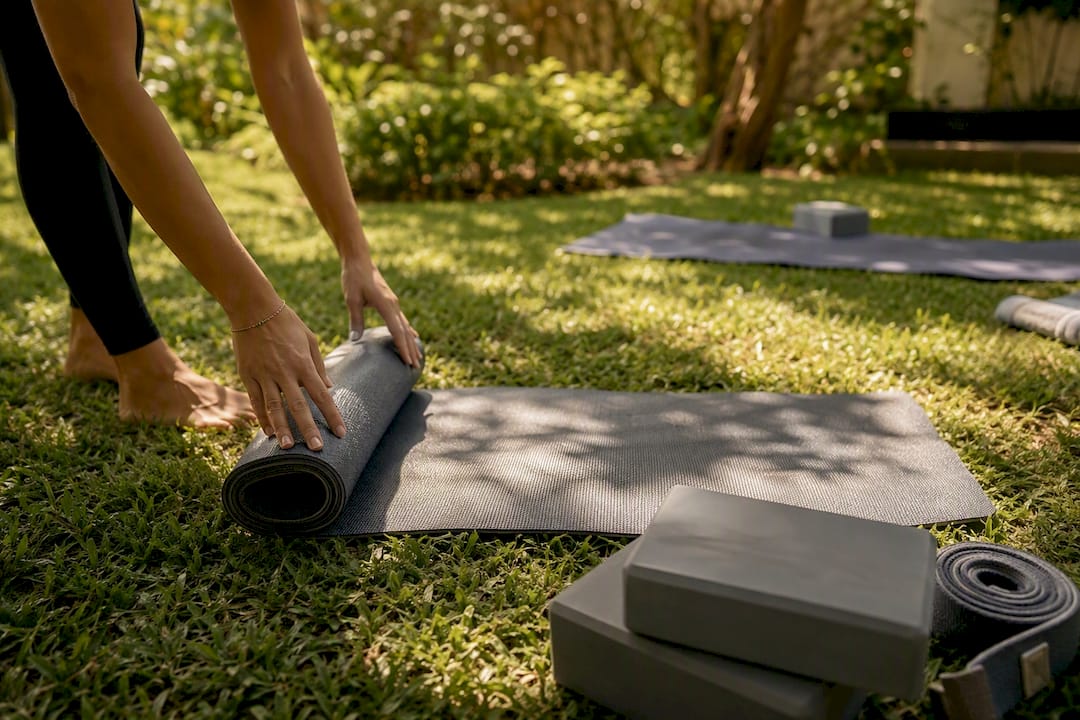
Community events are the differentiator that separates a coworking space from a coworking-plus-wellness experience. Expect a mix of professional programming (networking mixers, skill shares) and wellness programming (yoga, breathwork, fitness classes). The frequency matters more than the variety: one event a month is a checkbox, three or four a week is a real culture.
Ask what a typical week looks like before booking. A space that can answer with specifics, not vague promises, is one that’s actually running the program it advertises.
How Do the Top Alternatives Compare on Pros and Cons?
Laying the categories side by side makes the trade-offs obvious fast.
Dedicated coworking wins on affordability and community density but loses on wellness and privacy. If your budget is tight and you mostly need a desk and some human contact, it delivers.
Boutique hotels with workspace corners win on comfort and hospitality polish but lose on actual work infrastructure. Great for a short trip, frustrating for sustained deep work.
Coliving-coworking hybrids win on convenience for travelers, since everything is under one roof and one booking, but quality varies wildly between operators. Vet carefully.
Private serviced offices win on privacy and predictability but lose on the community and wellness angle almost entirely. You’re paying for a door, not a lifestyle.
Hospitality-led hybrids that build in wellness and accommodation as a core offering, rather than an afterthought, tend to win across the most categories at once: productivity, recovery, and social connection in a single package. The trade-off is usually price. You’re paying for integration, not just square footage.
Where Are These Alternatives Actually Available?
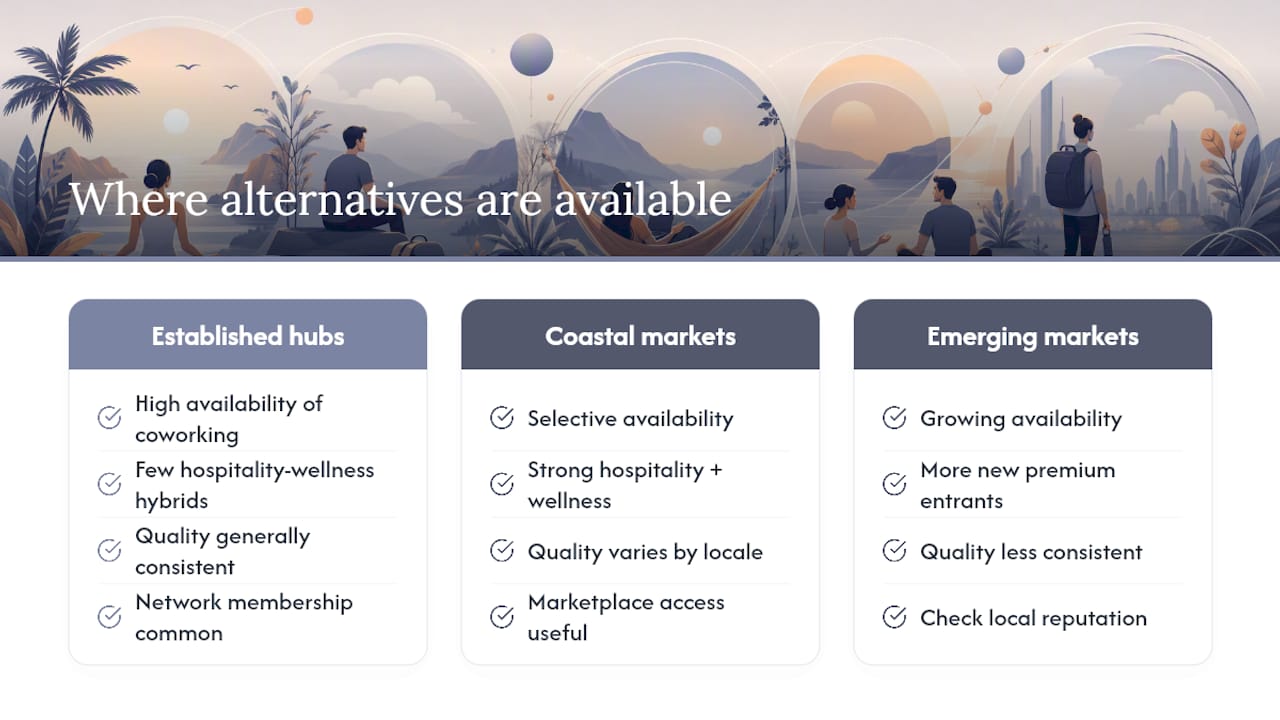
Availability varies a lot by market, and this is where a lot of searches go sideways. Dense urban hubs (major European and North American cities) have no shortage of dedicated coworking chains, but hospitality-led hybrids with real wellness infrastructure cluster in fewer, more specific locations. Coastal and lifestyle-driven markets, think southern Spain, parts of Southeast Asia, and a handful of Latin American cities, tend to attract this model because the audience (remote workers, digital nomads) overlaps with people who came for the lifestyle, not just the Wi-Fi.
Emerging markets are shifting fast here. Industry coverage of the coworking sector points to growing operator investment in turnkey, hospitality-driven premium spaces in cities that weren’t on the radar a few years ago. That’s good news if you’re location-flexible, but it also means quality control varies more in newer markets than in established ones.
If you’re planning a multi-city work trip, check whether a space belongs to a network with multiple locations. Marketplace-style access models let you book premium workspace in different cities without renegotiating terms every time, which matters if your work takes you from one coast to another every few months.
Local reputation still beats a slick website. A quick search for reviews specific to the city you’re headed to will tell you more than any marketing page.
What Tech and Connectivity Should You Expect?
Wi-Fi speed is the single most common complaint in this category, and it’s almost always avoidable if you ask the right question before booking. Anything under 100 Mbps shared across a busy floor is going to choke during a video call scrum. Ask for the actual number, and ask whether it’s dedicated bandwidth or shared with the whole building.
Beyond raw speed, look for wired ethernet options at desks (not just Wi-Fi), backup connectivity in case the primary line drops, and video-call-ready meeting rooms with proper microphones and screens, not a laptop propped on a stack of books.
Booking technology is part of the tech stack too. Spaces running on modern operator platforms tend to have smoother booking, billing, and access systems, which sounds boring until you’re the one stuck emailing someone at 11pm because the app won’t let you reserve a room for tomorrow morning. Keyless entry via mobile app has become close to standard at premium spaces, and its absence is worth noting as a gap.
Print and scan availability, decent noise-canceling booth options for calls, and reliable power outlets at every desk round out the baseline. None of this is glamorous. All of it is the difference between a productive day and a frustrating one.
Which Alternative Fits Your Specific Work Style?
Not every space fits every person, and pretending otherwise wastes everyone’s time.
Solo freelancers usually get the most value from dedicated coworking or hospitality-led hybrids, since community and structure matter more when you don’t have office-mates by default.
Small teams (2 to 9 people) tend to do best with private serviced offices or a private office within a larger coworking building, where you get a door that closes but still have shared amenities like meeting rooms and a kitchen down the hall.
Digital nomads benefit most from coliving-coworking hybrids or hospitality-led venues with accommodation bundled in, since the convenience of one booking covering both work and sleep removes a huge chunk of trip-planning friction. If you’re mapping out longer stints abroad, it’s worth cross-referencing broader digital nomad travel patterns before you commit to a base city.
Entrepreneurs building a team on the ground often need a mix: private office for the core team, plus flexible day passes for contractors and visitors.
Anyone prioritizing wellbeing over pure cost should lean toward hospitality-first models with real wellness infrastructure baked in, not bolted on, since that’s where the health and focus benefits actually show up consistently.
Why Hospitality-First Coworking Wins on Wellbeing
Here’s the thing most coworking guides skip: the wellness numbers aren’t fluff. Centro House members report significantly improved health and better concentration, and the venue picked up “Best Office in Spain” from the European Property Awards. That’s not a marketing footnote, that’s a measurable outcome tied to how the space is built.
Academic literature backs this up more broadly. Coworking environments can meaningfully affect wellbeing and quality of work life through physical layout, social programming, and material amenities. Hospitality-first models take that seriously by design.
Practically, this means less friction for traveling professionals, real recovery time via gym and pool access, and scheduled events that actually build a network instead of just decorating a calendar.
That said, if you’re deeply local, rarely travel, and your home office already works, a simpler dedicated coworking space or even staying home might be the better call. Not every situation needs the full hospitality package.
— Caroline
How to Book a Trial or Membership at Centro House
Centro House in Marbella runs on exactly the model this whole guide has been describing: hotdesks, private offices for teams of 2 to 9, meeting rooms by the hour, and on-site executive accommodation, all wrapped around a gym, pool, terrace, and a genuine event calendar. You’re not stitching together three separate bookings. It’s one.

The offering breaks down simply:
- Hotdesk and fixed desk access for daily or monthly use
- Private offices for small teams who need a door
- Meeting rooms bookable by the hour
- Executive accommodation for short or extended stays
- Gym, pool, and terrace access included in membership
- Regular wellness classes and networking events
They’re the reason a lot of members switch from a plain desk rental to something that actually supports the whole workday.
If you want to test the model before committing, book a day pass or a short-stay-plus-desk bundle. Check current coworking rates and membership tiers, browse the private office options, or explore executive accommodation for a work trip that doesn’t require juggling two separate bookings.
Sources
A few sources worth bookmarking if you want to go deeper on this topic:
- 5 evolving coworking markets that caught our eye in 2026
- 5 coworking & flex space trends for 2026 (OfficeRnD)
- Wellness and Fitness Amenities in Modern Coworking