
For digital nomads, the single best daily practice is a short daily yoga micro-flow each morning plus brief mobility breaks regularly during desk time. That’s it. No studio, no mat, no hour-long commitment required.
Start right now with these three moves:
- 3-breath grounding: Sit tall, inhale for 4 counts, hold for 2, exhale for 6. Repeat three times. Your nervous system will thank you.
- Chin tucks: Draw your chin straight back (hello, double chin, goodbye tech neck). Hold 5 seconds, repeat 10 times.
- Seated spinal twist: Sit upright, place your right hand on your left knee, rotate gently left. Hold 30 seconds each side.
Mayo Clinic recommends breaking up prolonged sitting with movement regularly throughout the workday, targeting hips, spine, and shoulders with focused short routines to prevent stiffness and reduce musculoskeletal strain.
That timing rule is your new non-negotiable. Set a phone timer, use a Pomodoro app, or just promise yourself you’ll move every 30–60 minutes during desk time, as recommended by mobility experts. Whatever works.
Table of Contents
- Why yoga for digital nomads actually changes the game
- Travel-friendly poses and what each one actually fixes
- Short sequences for travel days that actually fit your situation
- How to build a yoga habit that survives your travel schedule
- Apps and gear that make a nomad practice actually portable
- Common nomad pain patterns and how to modify safely
- A 15-minute nomad micro-flow you can do in a hotel room right now
- What the research actually says about movement timing and practice length
- Key Takeaways
- The part nobody tells you about yoga on the road
- Useful sources and next steps
Why yoga for digital nomads actually changes the game
Your body was not designed for a 14-hour Lisbon-to-Bangkok itinerary followed by a wobbly café chair and a laptop balanced on a pillow. Hip flexors shorten after hours of sitting. Shoulders round forward toward screens. Lower backs quietly stage a protest. And jet lag? That’s your nervous system filing a formal complaint.

A consistent 10–15 minute daily yoga practice produces measurable improvements in stress levels, sleep quality, posture, and energy for remote workers. Not 90 minutes. Not a retreat in Bali. Fifteen minutes.
Here’s what that time actually buys you:
- Posture reset: Counteracts rounded shoulders and forward head position from screen time.
- Hip mobility: Reverses hip flexor shortening from long flights and extended sitting.
- Circulation: Seated stretches and breathwork keep blood moving during transit and long work sessions.
- Nervous-system regulation: Slow breathing activates the parasympathetic system, cutting cortisol and easing jet lag recovery.
- Sleep quality: A short evening wind-down practice signals the body it’s time to rest, even in a new time zone.
- Sustained attention: Reduced physical tension means fewer mental interruptions during deep work.
A short, repeatable yoga practice does more than stretch muscles. For nomads, it often becomes a cognitive anchor — a familiar ritual that signals stability in an otherwise chaotic travel routine, and that psychological consistency can deliver long-term productivity benefits.
The anchor effect is real. When everything else changes — city, bed, coworking space, time zone — a five-minute morning ritual stays constant. That predictability is surprisingly powerful.
Travel-friendly poses and what each one actually fixes
Yoga scales beautifully for nomad life because it needs zero equipment, fits a hotel room corner, and directly targets the exact problems desk life creates. Here’s your compact toolkit:
- Chin tucks: Fixes forward head posture and tech neck. Draw chin straight back, hold 5 seconds, repeat 10 times.
- Neck rolls: Releases upper trapezius tension. Slow, controlled half-circles, never full backward rolls.
- Shoulder rolls: Clears shoulder and upper back stiffness. 10 forward, 10 backward, breathe deeply.
- Seated cat–cow: Mobilizes the whole spine. Sit at the edge of a chair, hands on knees, alternate arching and rounding the back.
- Seated spinal twist: Decompresses lumbar vertebrae and improves thoracic rotation. Right hand on left knee, rotate gently, hold 30 seconds.
- Seated forward fold: Lengthens hamstrings and calms the nervous system. Hinge at hips, let the torso drape forward over the legs.
- Low lunge (Crescent): Opens hip flexors aggressively shortened by sitting. Back knee down, front knee over ankle, hips square.
- Downward dog: Decompresses the spine and opens shoulders after long travel. Hands shoulder-width, feet hip-width, push hips toward the ceiling.
- Sphinx pose: Gentle backbend that counteracts forward rounding without stressing the lower back. Forearms on the floor, elbows under shoulders.
- Wrist stretches: Essential for anyone typing all day. Extend one arm, gently pull fingers back with the other hand, hold 20 seconds each side.
Pro Tip: No mat? No problem. A folded bath towel works for kneeling poses, a rolled sweater cushions your wrists, and a scarf doubles as a strap for forward folds. You already packed all of this.
For alignment, one rule covers most poses: keep your spine long before you add any rotation or forward bend. Collapsing first and stretching second is how people tweak things on day one of a new city.
Short sequences for travel days that actually fit your situation
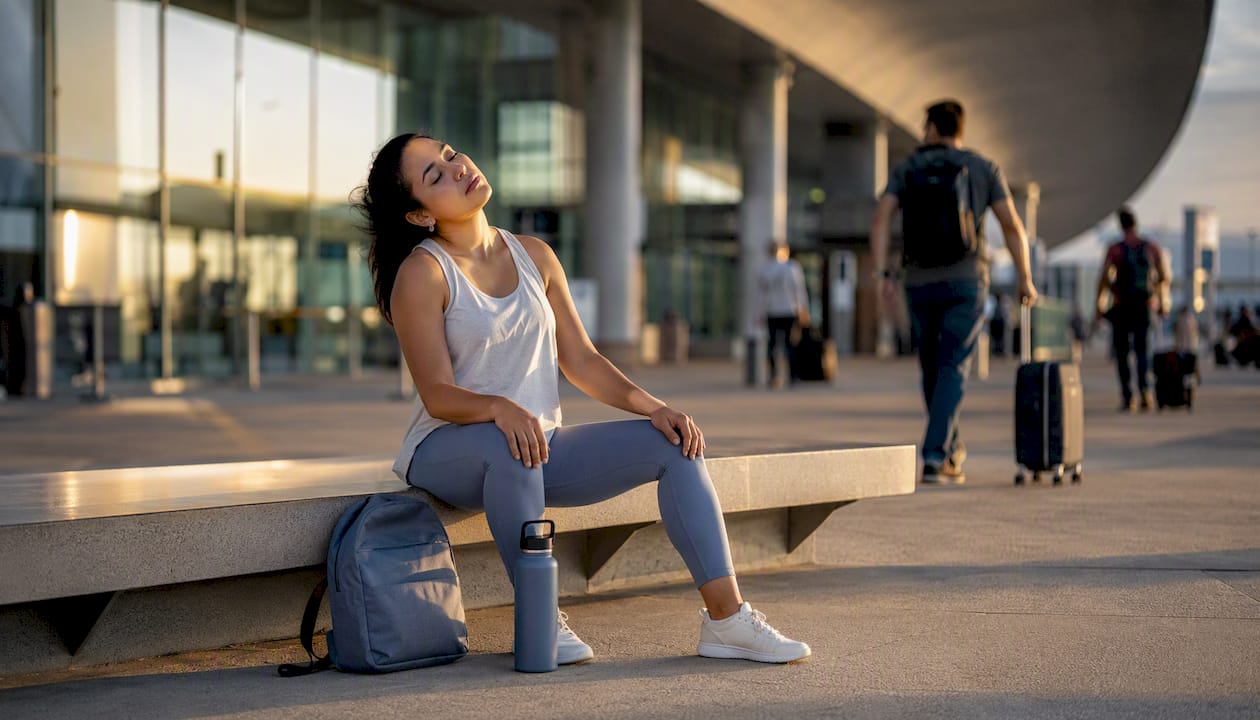
Long travel days are exactly when most nomads skip their practice entirely. The logic is understandable: you’re exhausted, the airport is chaotic, the hotel room smells like mystery carpet. But targeted stretches and breathwork during transit are precisely when they matter most, reducing stiffness and protecting circulation when you’re stuck in a seat for hours.
The fix is situational sequences, not a full class.
Post-flight reset (15 minutes, hotel room)
Do this within an hour of landing. Start with 2 minutes of slow diaphragmatic breathing lying on your back, knees bent. Move into seated cat–cow for 2 minutes, then low lunge on each side (2 minutes per side), sphinx for 2 minutes, and finish with legs-up-the-wall for 3 minutes. The goal is circulation and spine decompression, not performance. Three distinct micro-flows targeting post-flight recovery, mid-workday decompression, and end-of-day restoration serve nomads far better than occasional long classes.
Airport/transit micro-break (5 minutes, any chair)
During layovers or long train rides, cycle through: neck rolls (1 minute), seated spinal twist (1 minute each side), seated forward fold (1 minute), and 10 rounds of box breathing (inhale 4, hold 4, exhale 4, hold 4). All of this is completely discreet. Nobody at the gate will notice, and if they do, they’ll probably ask you to teach them.
Café-chair decompression (5–7 minutes, mid-workday)
Step away from the screen. Shoulder rolls, chin tucks, seated cat–cow, and a 2-minute forward fold over your legs. Finish with 5 slow exhales, longer than the inhales. This sequence targets the tension pattern that builds after two hours of typing in a chair that was designed for someone ordering a flat white, not writing a product roadmap.
Travel yoga focuses on accessible seated stretches, breathwork, and mindful movement — no mat or studio required. The goal is nervous-system regulation and mobility, not intensity.
How to build a yoga habit that survives your travel schedule
The number one reason nomads drop their practice is trying to maintain a studio-style routine on the road. It doesn’t work. What does work is anchoring a micro-practice to something that already happens every day.
Drink coffee every morning? Do your 10-minute flow before the first cup. Close your laptop at the end of the workday? Three minutes of breathwork before you shut the lid. These habit anchors require zero motivation because the trigger is already built in.
Here’s a practical weekly cadence:
- Daily minimum: 10–15 minute morning micro-flow (non-negotiable, even on travel days — do it in the airport if needed).
- Work-break micro-sessions: 5-minute mobility routine every 30–60 minutes of desk time.
- 2–3 times per week: A 20–30 minute guided session using an app or YouTube.
- Low-travel weeks: One 45–60 minute full class, either on a platform or in-person.
Pro Tip: Pair your yoga habit with a proper ergonomic setup. A hotdesk at Centro House in Marbella gives you an adjustable workstation, a gym, a pool, and scheduled on-site yoga classes with a real instructor. Yoga repairs the damage; a good chair prevents it. Both matter.
Centro House members report that 70% experience improved health and 68% better concentration after using the facilities and wellness services. That combination of ergonomics plus structured movement is exactly what the research supports.
Apps and gear that make a nomad practice actually portable
The right tools make the difference between a practice that travels and one that quietly dies in a Lisbon Airbnb. Here’s what to prioritize.
App comparison
| App / Platform | Best for | Session length | Cost | Offline available | Focus |
|---|---|---|---|---|---|
| Yoga with Adriene (YouTube) | Beginners, free practice | 10–60+ min | Free | No (save videos manually) | Posture, mobility, breath |
| Down Dog | Customizable micro-flows | 5–60 min | Free trial, then subscription | Yes (downloadable) | Flexibility, energy, recovery |
| Glo | Structured programs | 20–60+ min | Subscription | Yes (select classes) | Posture, breath, relaxation |
| Insight Timer | Meditation + breathwork | 5–45 min | Free tier + premium | Yes (premium) | Mindfulness, nervous system |
| Alo Moves | Intermediate/advanced flows | 15–60+ min | Subscription | Yes (downloadable) | Mobility, strength, recovery |
For nomads specifically, offline download capability is the feature that separates useful from useless. A 12-hour flight with no Wi-Fi will expose every app that doesn’t let you save classes locally.
Gear worth packing
- Travel yoga mat: A 1.5mm foldable mat (brands like Manduka eKO Superlite or Liforme Travel) fits in a carry-on.
- Yoga strap or resistance band: Doubles as a luggage strap. Genuinely useful for hamstring and shoulder stretches.
- Mini foam block: Some collapse flat. If yours doesn’t, a thick hardcover book works fine.
- Grip socks: For hotel rooms where the floor is either slippery or unknowable.
Skip the bolsters, the blocks that don’t fold, and anything that requires checking a bag. The best gear is whatever you’ll actually bring.
Common nomad pain patterns and how to modify safely
Yoga is a recovery tool, not a cure-all. Nomads who treat it as a substitute for ergonomics or medical care tend to make things worse, not better. Know your patterns before you practice.
- Tech neck (forward head posture): Avoid deep cervical flexion. Prioritize chin tucks, gentle neck rolls, and thoracic extension (sphinx, chest openers). Never force neck circles through pain.
- Hip flexor shortening: Low lunge and pigeon pose are your friends, but ease in slowly after long flights. Aggressive hip openers on arrival day can strain already-inflamed tissue.
- Lower back irritation: Skip deep forward folds and heavy twists for the first 24 hours after a long flight. Prioritize cat–cow, sphinx, and supine knee-to-chest instead.
- Wrist strain: If you’re typing 6+ hours a day, wrist stretches are non-negotiable. Avoid weight-bearing poses like plank or downward dog during flare-ups.
- Jet lag and nervous-system dysregulation: Skip vigorous flows when severely jet-lagged. Breathwork, legs-up-the-wall, and restorative poses regulate the nervous system far better than a sweaty power flow at 3 AM local time.
Stop and consult a physical therapist or healthcare provider if you experience sharp, shooting, or radiating pain during any pose; numbness or tingling in the arms, hands, legs, or feet; sudden worsening of existing back or neck symptoms; or pain that persists more than 48 hours after practice. Discomfort is normal. Pain is a signal.
One practical rule: simple seated stretches and breathwork are the safest entry point after any long travel period. Save the deep hip openers and inversions for day two.
A 15-minute nomad micro-flow you can do in a hotel room right now
This sequence works in roughly 6 feet by 4 feet of floor space. No mat required, though a towel helps for kneeling.
Warm-up (3–4 minutes)
- Diaphragmatic breathing, lying on your back: 10 slow breaths, exhale longer than inhale.
- Supine knee-to-chest: pull each knee in gently, hold 30 seconds per side.
- Seated cat–cow: 10 slow rounds at the edge of the bed or a chair.
Mobility and core (6–8 minutes)
- Low lunge, right side: hold 60 seconds, focus on squaring the hips.
- Low lunge, left side: hold 60 seconds.
- Downward dog: hold 45 seconds, pedal the heels gently.
- Seated spinal twist: 45 seconds each side.
- Sphinx pose: hold 60 seconds, breathe into the belly.
- Wrist stretches: 20 seconds each direction, both hands.
Nervous-system calm (2–3 minutes)
- Legs-up-the-wall (or legs elevated on the bed): hold 2 minutes.
- 5 rounds of box breathing to close: inhale 4, hold 4, exhale 4, hold 4.
Pro Tip: Use this 15-minute sequence on travel days and standard workdays alike. On low-travel weeks when you have more time, extend the mobility section to 15 minutes and add a 10-minute guided meditation on Insight Timer. On brutal travel days, cut everything except the warm-up and the box breathing — 5 minutes is infinitely better than zero.
Yoga can be performed in a tiny apartment, hotel room, or airport corner, and poses directly counteract the most common sitting-related issues. The space constraint is never the real barrier.
What the research actually says about movement timing and practice length
The recommendations in this article aren’t arbitrary. They’re grounded in clinical guidance and mobility research.
Mayo Clinic’s desk-stretch guidance is explicit: prolonged sitting places significant stress on the neck, shoulders, and upper back, and regular movement breaks are the primary intervention. The 30–60 minute timing rule comes directly from that framework.
A focused 5-minute routine targeting hips, spine, and shoulders reduces stiffness and improves posture when done consistently throughout the workday. Five minutes. That’s one Instagram scroll session redirected.
The Cleveland Clinic recommends seated cat–cow, seated spinal twist, neck rolls, shoulder rolls, and seated forward fold as a clinician-backed set for travel-related stiffness and stress relief. Every one of those poses appears in the sequences above.
For nomads specifically, these findings map to three recurring scenarios:
- Transit: Seated stretches and breathwork every 30–60 minutes prevent the inflammation that makes arrival-day recovery so brutal.
- Jet lag: Nervous-system regulation through breathwork and restorative poses outperforms vigorous exercise when the circadian rhythm is disrupted.
- Inconsistent sleep: A short evening practice (10 minutes of breathwork and restorative poses) signals sleep onset more reliably than scrolling, regardless of time zone.
The evidence points consistently in one direction: short, frequent movement beats occasional long sessions for nomads. That’s not a compromise. It’s the actual prescription.
Key Takeaways
A daily 10–15 minute yoga micro-flow plus 5-minute mobility breaks every 30–60 minutes is the most evidence-backed, travel-proof practice a digital nomad can build.
| Point | Details |
|---|---|
| Daily minimum practice | 10–15 minutes of yoga daily produces measurable improvements in stress, sleep, and posture for remote workers. |
| Movement break timing | Move every 30–60 minutes of desk time; a 5-minute hip, spine, and shoulder routine is enough to prevent stiffness. |
| Travel-day sequence | The 15-minute hotel-room micro-flow (warm-up, mobility, breathwork) works in 6×4 feet with no equipment. |
| Best apps for nomads | Down Dog and Glo offer offline downloads; Yoga with Adriene is free; Insight Timer covers breathwork and meditation. |
| Pair yoga with ergonomics | Yoga repairs damage; a proper workstation prevents it. Centro’s coworking space in Marbella combines both. |
The part nobody tells you about yoga on the road
Most articles about yoga for travelers will tell you to “find a local studio” or “commit to a morning routine.” Both are fine advice for someone with a fixed address and a predictable schedule. For nomads, they’re about as useful as telling someone to “just sleep more” when they’re crossing five time zones every three weeks.
The real insight from working with nomads is this: the practice that survives is the one that requires the least decision-making. Not the most beautiful sequence. Not the longest class. The one you can do half-asleep in a hotel room at 7 AM before you’ve figured out what country you’re in.
That’s why micro-flows work and studio commitments don’t. A 15-minute sequence with a fixed structure removes the cognitive load entirely. You don’t decide what to do. You just do it. And over time, that consistency compounds into genuine physical and mental resilience, the kind that makes a 14-hour travel day feel manageable instead of catastrophic.
The other thing worth saying: yoga is not a substitute for a decent workspace. Nomads who pair a consistent movement practice with proper ergonomics report far fewer chronic issues than those relying on stretches alone. If you’re spending extended time in one place, it’s worth investing in a workspace that supports both. Centro’s on-site yoga classes with Nicole and ergonomic facilities exist precisely because the combination works better than either alone.
Useful sources and next steps
Ready to go deeper? Here’s where to start:
- Mayo Clinic desk stretches: The clinical foundation for movement-break timing and upper-body stretch protocols.
- Cleveland Clinic travel yoga guide: Five clinician-recommended poses for travel stiffness and circulation.
- Art of Living travel yoga poses: Practical pose guidance including breathwork for travelers.
- Yoga with Adriene: Free YouTube library with hundreds of short, beginner-friendly flows. Best for nomads who want guided practice without a subscription.
- Nomad-friendly accommodation in Greece: Practical guide for remote workers choosing stays with reliable space for practice and good Wi-Fi.
- Centro House, Marbella: On-site yoga instruction, gym, pool, ergonomic coworking, and luxury accommodation for nomads who want the full setup in one place.
For free vs. paid: if you travel more than two weeks per month, the offline download feature alone justifies a Down Dog or Glo subscription. If your travel is lighter, Yoga with Adriene and the free tier of Insight Timer cover everything you need.
This article is for general informational purposes only and is not a substitute for professional medical or physical therapy advice. Consult a qualified healthcare provider before starting a new exercise program, especially if you have existing injuries or chronic pain.